Why Foaming Technology Is the Hidden Key to High Speed Cable Performance in AI and Data Center Infrastructure?
- Share
- Issue Time
- Mar 31,2026
Summary
This article explains how FEP foaming technology improves high speed cable performance for AI servers and data center cable infrastructure.
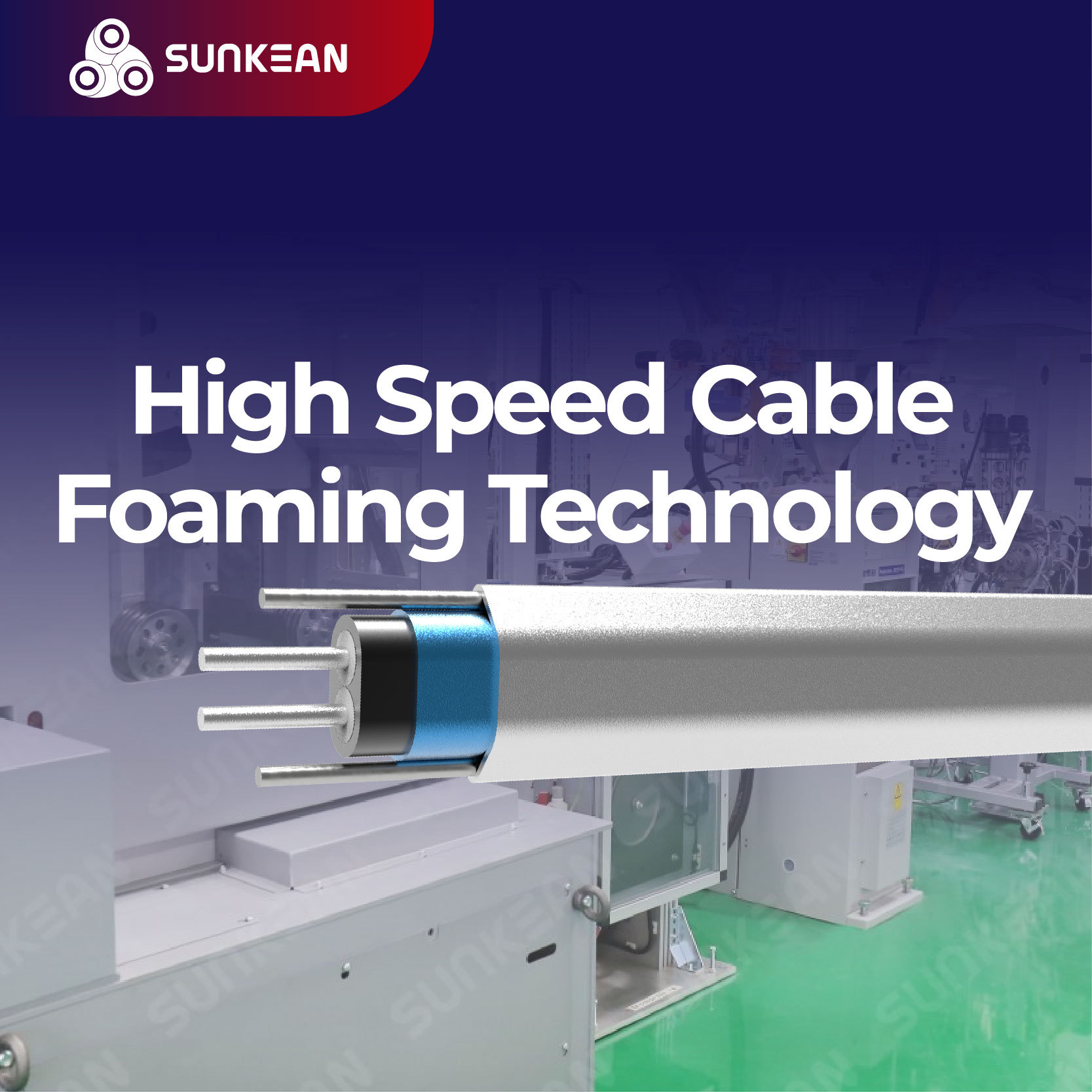
As high-speed interconnect technology rapidly moves into the 112G, 224G, and next-generation transmission era, competition in the high speed cable industry is no longer defined only by conductor materials or structural geometry. Instead, one of the most critical performance factors now lies inside the insulation layer itself—foaming technology.
More engineers designing data center cable systems are recognizing that insulation microstructure consistency directly determines signal integrity, attenuation performance, and long-term reliability. Today, the precision of foaming process control has become a defining benchmark separating standard cable manufacturing from advanced high-speed interconnect engineering. For companies supporting AI computing infrastructure and hyperscale deployments, mastering foamed insulation technology is no longer optional—it is essential.
The Principle of Foaming Technology in High Speed Cable Manufacturing
In high speed cable design, foaming refers to the creation of microscopic air cells inside the insulation material. These controlled micro-bubbles reduce dielectric constant and signal loss while improving transmission speed across copper interconnect structures. From an electromagnetic perspective, air has a dielectric constant close to 1, making it the ideal transmission medium. The engineering goal of foamed insulation in modern data center cable systems is therefore straightforward: replicate the electrical behavior of air as closely as possible within a stable polymer structure.
However, achieving this performance advantage depends on uniformity and stability, not simply increasing the foaming ratio. If bubble sizes vary across the insulation layer—or if partial collapse occurs during extrusion—the electrical characteristics fluctuate. That variation directly impacts impedance stability, insertion loss, and crosstalk control, especially at 112G and 224G signaling rates.
This is why advanced high speed cable manufacturers focus on maintaining consistent microstructure across every meter of cable rather than maximizing expansion percentage alone.
Why FEP Foamed Insulation Is Critical for Data Center Cable Performance
Among insulation materials used in high speed cable systems, foamed FEP (Fluorinated Ethylene Propylene) has become one of the most reliable solutions for high-frequency environments.
FEP offers several advantages for next-generation data center cable architectures:
· Excellent dielectric stability at high frequencies
· Strong thermal resistance for continuous operation
· Low signal attenuation characteristics
· Reliable impedance consistency across long cable lengths
However, FEP is significantly more difficult to process than conventional insulation materials, particularly in next-generation high speed cable and data center cable applications. It requires a much narrower extrusion temperature window and highly stable material flow control, because even small fluctuations can affect foaming uniformity, impedance consistency, and signal integrity at 112G and 224G transmission speeds. During physical foaming, key variables such as gas injection ratio, melt temperature, extrusion pressure, and line speed must remain precisely synchronized to maintain a stable microcellular insulation structure. Any instability may lead to dielectric variation or structural inconsistency along the cable length, directly impacting performance reliability. For this reason, only manufacturers equipped with advanced extrusion platforms and real-time inline monitoring systems can consistently ensure the electrical stability and production repeatability required for high-performance high speed cable manufacturing in modern data center cable environments.
How Foaming Technology Improves Signal Integrity in Data Center Cable Systems
From a system-level engineering perspective, foamed insulation improves signal performance by reducing dielectric coupling between adjacent conductors.
Lower dielectric constant results in:
· reduced insertion loss
· lower near-end crosstalk (NEXT)
· improved far-end crosstalk (FEXT)
· better impedance stability
These advantages become especially important in AI server clusters and hyperscale data center environments, where thousands of parallel signal channels operate within confined rack architectures. High-density routing leaves little tolerance for signal degradation. In this environment, the insulation layer inside each high speed cable plays a decisive role in maintaining reliable high-frequency transmission.
Lightweight Cable Structures Improve Installation Efficiency in AI Infrastructure
Another practical benefit of foaming technology is mechanical optimization. Properly engineered foamed insulation enables data center cable structures to remain lightweight while preserving electrical performance. This provides measurable advantages inside high-density rack environments:
· easier cable routing
· improved airflow management
· simplified maintenance operations
· reduced structural load inside cabinets
As AI infrastructure scales rapidly worldwide, installation flexibility is becoming nearly as important as electrical performance when selecting high speed cable solutions.
Precision Foaming Requires Advanced Manufacturing Equipment
In the field of fluoropolymer foaming extrusion, Austrian Rosendahl systems are widely recognized as one of the most advanced platforms for producing high-performance insulation structures used in data center cable applications. During physical foaming extrusion, multiple parameters must be precisely synchronized:
· gas injection ratio
· melt temperature
· extrusion pressure
· conductor line speed
These variables are strongly coupled. Without integrated process coordination, insulation uniformity cannot be maintained across production runs. Modern high speed cable manufacturing therefore depends on shifting foaming control from experience-based adjustment to predictable, repeatable process engineering supported by real-time monitoring systems.
How SUNKEAN Supports 112G and 224G High Speed Cable Production
Based on this manufacturing philosophy, SUNKEAN has established a complete production and validation system around precision foaming technology for next-generation copper interconnect solutions. By integrating: Rosendahl fluoropolymer foaming extrusion platforms, inline diameter and concentricity monitoring systems, high-frequency network analysis testing capability.
SUNKEAN production lines support engineering verification and scalable manufacturing for 112G and 224G high speed cable architectures used in modern AI and hyperscale data center cable deployments. More importantly, the coordination between equipment, monitoring infrastructure, and process control enables stable quality output rather than isolated performance improvements. As computing infrastructure continues evolving toward higher bandwidth density and lower latency requirements, this level of manufacturing integration positions SUNKEAN to deliver reliable high speed cable solutions for future AI-driven data center environments.